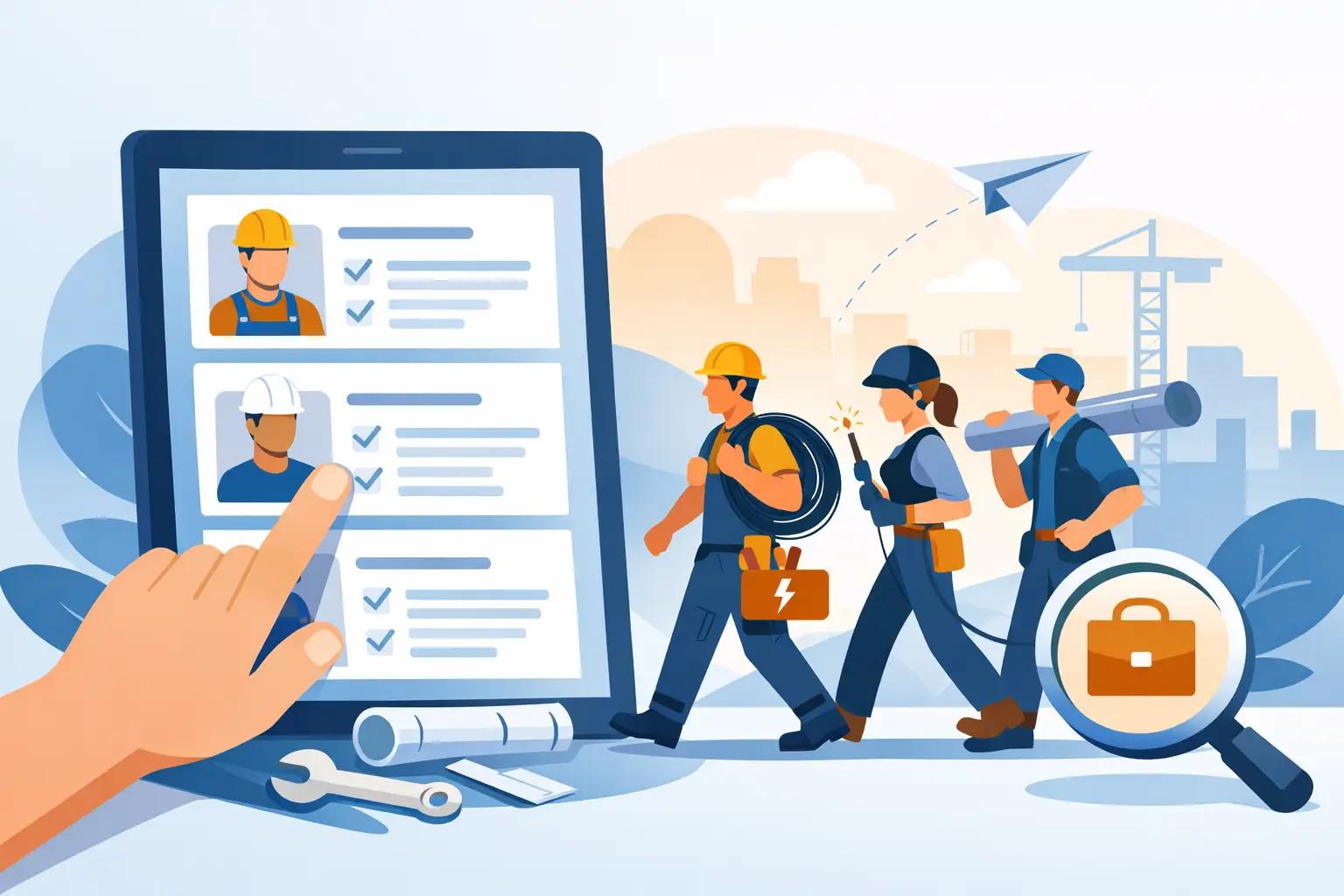

A subcontractor can lose money before the first tool hits the slab. One delayed electrician, one no-show welder, or one rushed hire without the right license can push a schedule off track and put margins under pressure fast. That is why construction staffing for subcontractors is not just a hiring task. It is an operations decision that affects production, safety, and client confidence.
Subcontractors hire under very different conditions than office-based businesses. Demand shifts by project phase. Labor needs spike with little warning. Crews must be productive on day one, not after three rounds of interviews and a week of paperwork. If your staffing process is slow, generic, or built around resumes instead of trade proof, you are already behind.
Why construction staffing for subcontractors is different
General hiring advice rarely fits the field. A subcontractor is not simply filling seats. They are matching labor to scope, timeline, jurisdiction, and supervision capacity. A commercial plumbing contractor staffing a hospital build has very different needs than a residential framing subcontractor scaling up for a subdivision.
That difference matters because the cost of a bad hire is higher in construction. If someone lacks the required skill level, the issue shows up immediately in rework, missed inspections, crew slowdowns, or safety exposure. If someone is qualified but unreliable, the foreman still pays the price in lost time and reshuffled assignments.
The best staffing approach for subcontractors starts with a simple reality: speed matters, but speed without verification creates expensive problems. You need both.
The real staffing problems subcontractors run into
Most subcontractors do not struggle because they do not understand hiring. They struggle because the labor market is fragmented and most hiring tools are built for jobs that are not project-based, field-driven, or trade-specific.
One common problem is poor candidate quality. Applications come in, but many are too broad, outdated, or impossible to validate quickly. A profile says commercial HVAC experience, but does it include rooftop unit installs, controls work, or service only? A candidate lists electrical work, but is that helper-level work or journeyman-level experience?
Another issue is timing. By the time a subcontractor posts a job, screens candidates, makes calls, and confirms credentials, the project need may have already changed. Some roles need to be filled in days, not weeks. Delayed hiring often forces companies to overwork current crews, borrow labor from another job, or accept lower standards just to keep moving.
Communication is also a major drag on hiring efficiency. Skilled trades hiring happens on phones, in trucks, between site walks, and after hours. If the process depends on desktop-heavy systems or long back-and-forth chains, good workers drop off and supervisors lose momentum.
Then there is trust. In construction, a name on a resume is not enough. Subcontractors need confidence that a worker has the licenses, experience, and jobsite behavior to perform in a live environment with real schedule pressure.
What a strong staffing system actually looks like
Good construction staffing for subcontractors is built around fit, proof, and response time. It should help you answer a few critical questions fast: Can this person do the work? Can they show up when needed? Can I verify their background without slowing down the project?
That means the hiring process has to move beyond generic applications. Trade category matters. Skill level matters. Location matters. Credential status matters. So does evidence of completed work. A subcontractor hiring a finish carpenter or pipefitter needs more than a short summary. They need signals that reduce guesswork.
This is where verified profiles, project portfolios, and trade-specific matching create a real advantage. When hiring data reflects field reality, staffing gets more precise. You spend less time filtering out weak fits and more time talking to candidates who can actually step onto the job.
How subcontractors should approach hiring by project need
Not every labor need should be treated the same way. A short-duration push to meet a deadline requires a different staffing move than building a bench of dependable tradespeople for recurring work.
For urgent project coverage, the priority is speed with guardrails. You need workers who are available now, close enough to the site, and already aligned to the trade and scope. Verification becomes even more important here because rushed hiring creates the highest risk of mismatch.
For ongoing workforce planning, the goal is repeatability. The smartest subcontractors are not hiring from zero every time a project starts. They are building a dependable pipeline of proven talent they can reactivate as demand shifts. That reduces downtime between opening a role and putting someone in the field.
There is also a middle ground. Some subcontractors need a flexible labor strategy that combines core employees with project-based hires. That model works well when backlog is strong but phase timing is uneven. It gives companies the ability to protect quality while staying lean enough to handle changing labor loads.
Why verification changes the game
A worker may interview well and still be the wrong fit. In the trades, proof matters more than polish. That is why verification should not be treated like an extra feature. It is the center of a reliable staffing process.
License checks help confirm compliance where required. Employment validation adds confidence that the worker has actually performed in the environments they claim. Background checks can reduce risk depending on the project and client requirements. Portfolios add another layer by showing what the worker has built, installed, repaired, or completed.
For subcontractors, this kind of validation shortens decision time. Instead of chasing references and trying to decode vague experience descriptions, you can compare workers on evidence. That leads to better hires and fewer surprises after onboarding.
Technology only works if it fits the field
Construction companies do not need more software for the sake of software. They need tools that remove friction. In staffing, that usually comes down to matching, messaging, and visibility.
AI-powered matching can be useful when it is trained around trade-specific variables instead of generic job titles. The right system should account for skill category, experience, credentials, location, and availability. That helps subcontractors get to a qualified shortlist faster.
Mobile-first communication matters just as much. A superintendent or owner is not sitting in a recruiting dashboard all day. They need to review candidates, message workers, and move hiring forward from the phone. Workers expect the same. If communication is fast and direct, placement happens faster.
That is one reason specialized platforms outperform broad hiring sites in the trades. A platform built for construction understands that staffing is tied to production schedules, not just job descriptions. go2work is designed around that reality, with verified worker profiles, trade-focused hiring workflows, and faster employer-worker communication.
What subcontractors should measure
If you want staffing to improve, track it like an operations function. Time-to-fill is the obvious metric, but it is not enough on its own. A fast hire that fails in the first week is not a win.
Look at show-up rate, retention through project milestones, rework linked to labor quality, and the percentage of hires that come from verified candidate sources. Also pay attention to how many roles require repeated posting. If the same positions stay hard to fill, your sourcing method may be too broad or your screening criteria may be unclear.
The strongest subcontractors treat hiring outcomes as job performance inputs. They know labor quality affects schedule reliability, customer satisfaction, and profitability just as much as material pricing or equipment uptime.
The trade-off every subcontractor has to manage
There is no perfect staffing model. Holding out for the ideal candidate can slow a job. Hiring too quickly can damage quality. Building a full in-house recruiting process may work for larger subcontractors, while smaller firms need a leaner system that still produces verified results.
That is why the best answer is usually not more hiring activity. It is better hiring structure. If your process gives you trade-specific visibility, faster communication, and trustworthy proof of skill, you can move quickly without operating blind.
Subcontractors win work on reputation, execution, and consistency. Staffing supports all three. When you can put qualified people on site faster, your crews stay productive, your projects stay tighter, and your business is in a better position to grow without gambling on labor. The right hire does more than fill a gap. It gives the whole project room to keep moving.